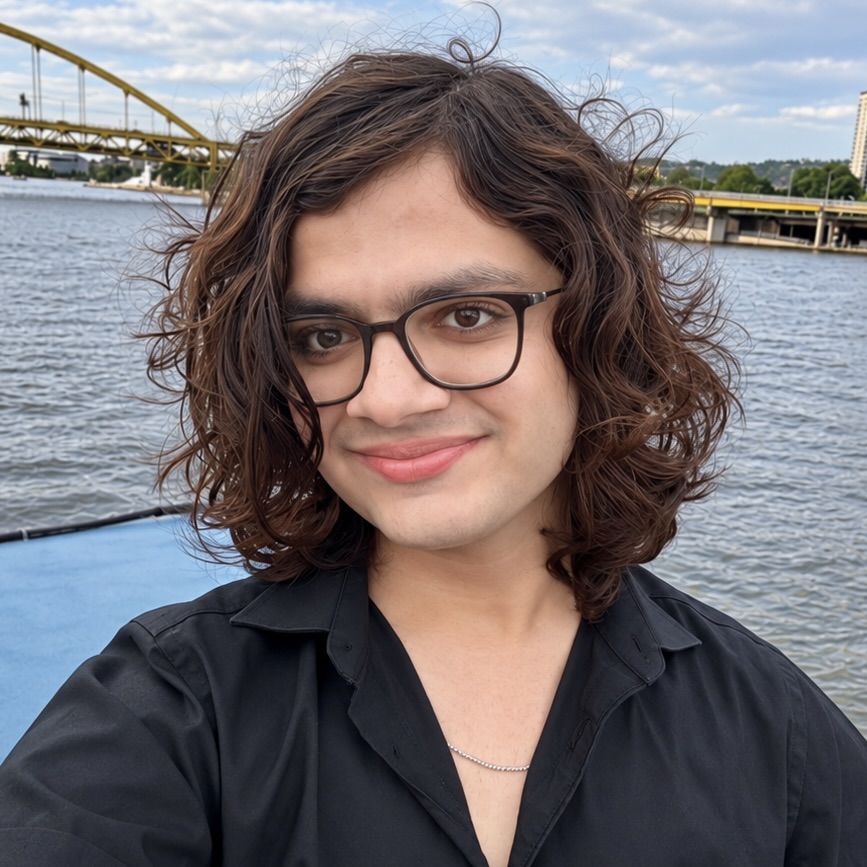
Hi, I'm Atharv. I'm an M.S. student in Machine Learning (MSML) at Carnegie Mellon University. I graduated from IIIT Delhi in 2025 with a B.Tech in Computer Science & Engineering, then worked as an applied AI researcher at Spyne. At CMU, I'm currently studying LLM Systems and Reinforcement Learning.
I'm interested in LLMs, RL, and the systems that make them work at scale. I'm especially interested in post-training, inference optimizations, and test-time scaling. Before this, my research covered active learning, OOD generalization, and data-efficient learning. Additionally, I have worked on Deep RL for compositional reasoning and built an LLM test-time adaptation system for ARC-AGI.
I'm looking for Summer 2027 internships related to LLMs, RL, agents, ML systems, and ML Engineering. If your team works on any of these, please email me at atharvg2@cs.cmu.edu. I'm always happy to chat!
I've been fortunate to work with and learn from Dr. Saket Anand, Dr. Gautam Shroff (TCS Research), Dr. Supratim Shit, and Dr. Pravesh Biyani. Each of them shaped how I approach research.
Outside of research, I play the piano and love classical music. I used to be a competitive speedcuber and a competitive gamer. I also have a (currently inactive) YouTube channel with my music shenanigans and the Rubik's Cube tutorials I made as a kid.
publications
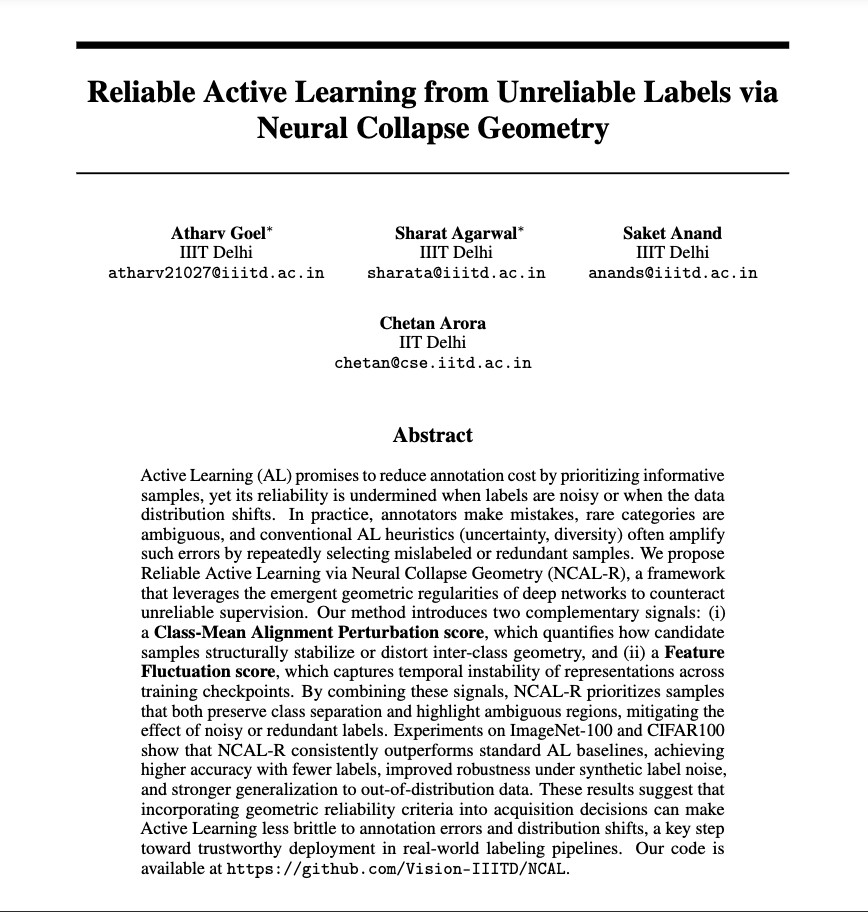
Reliable Active Learning from Unreliable Labels via Neural Collapse Geometry
NeurIPS 2025 Workshop on Reliable ML
Active learning (data selection) method (CMAP) that uses neural collapse geometry to pick what to label: it scores each unlabeled sample by how much it would perturb the learned class geometry. Reaches strong accuracy with about 20% fewer labels on ImageNet, and is more robust to label noise and more generalizable to OOD data and novel classes. Validated on OOD detection, long-tailed data, transfer learning, and novel-class discovery.
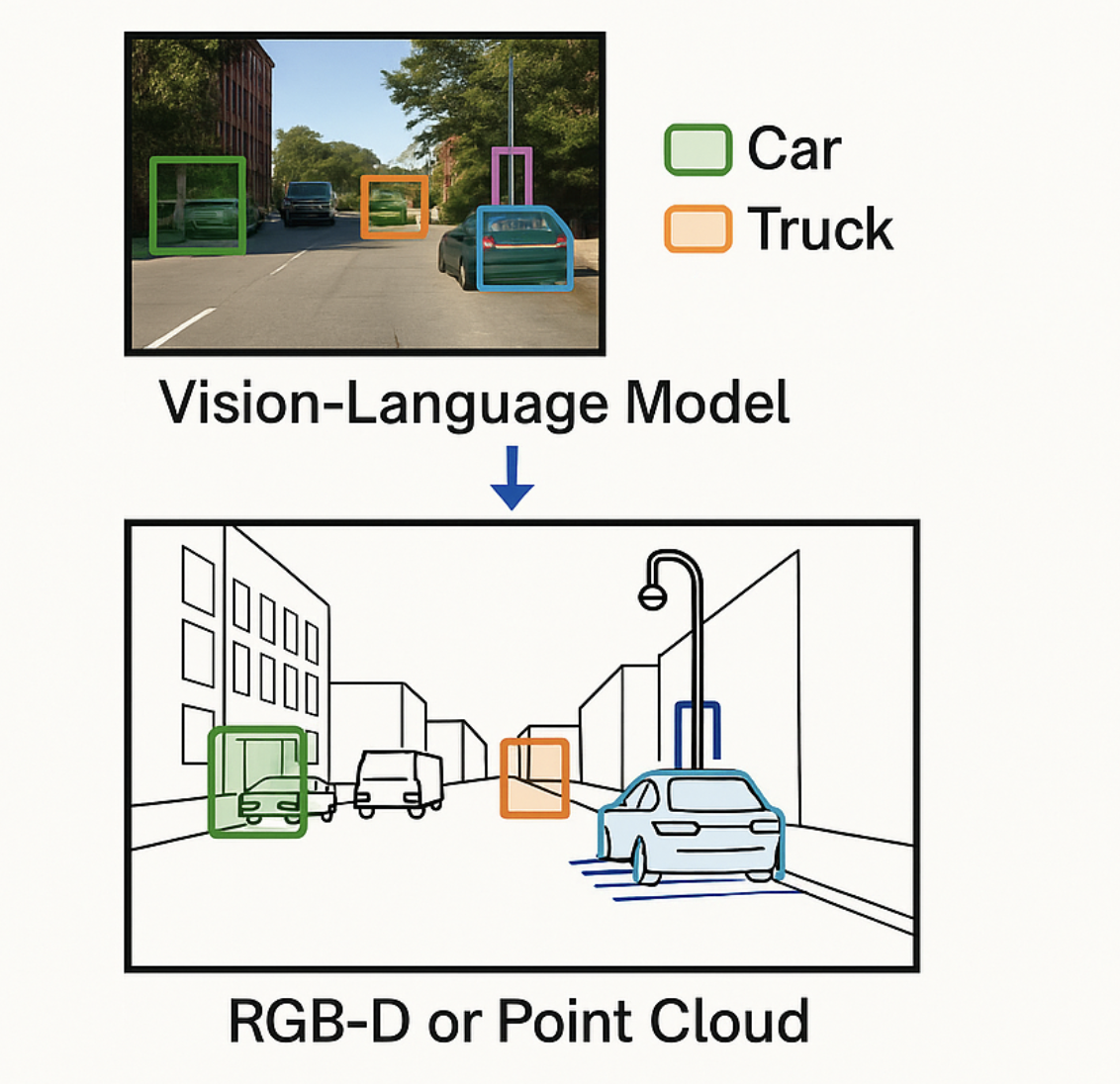
Just Add Geometry: Gradient-Free Open-Vocabulary 3D Detection Without Human-in-the-Loop
arXiv preprint (2025)
Training-free, annotation-free pipeline that composes 2D vision-language foundation models with classical geometry (camera models and LiDAR) for open-vocabulary 3D detection. Also introduces a robustness benchmark with physics-based fog simulation and unreliable LiDAR, which exposes severe failures under sensor and distribution shift.
projects
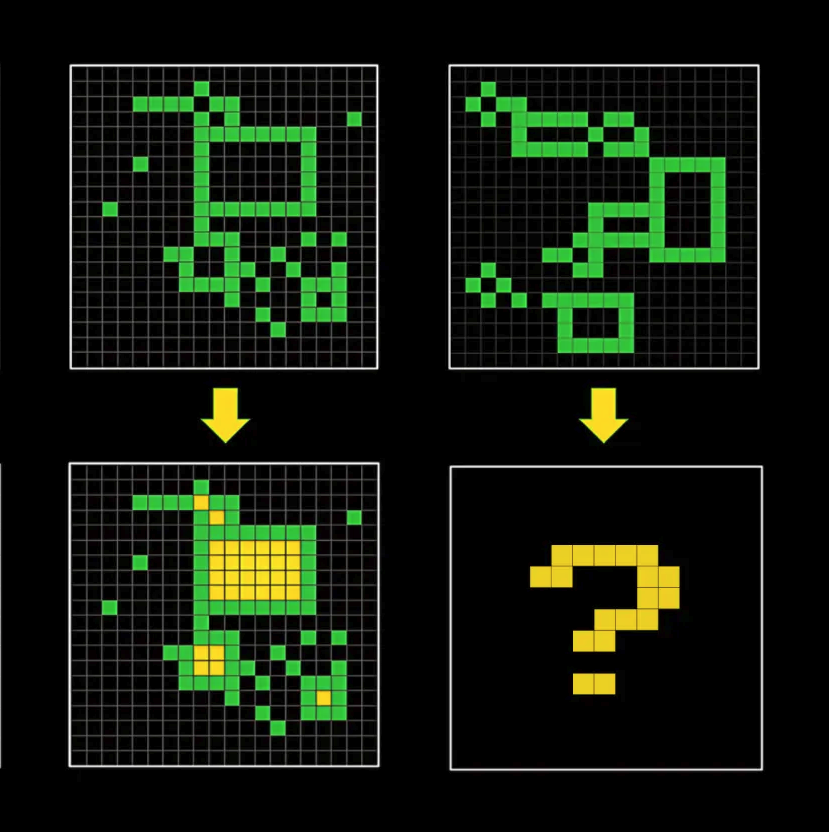
Neural Analogical Reasoning for ARC-AGI
Neurosymbolic system for the ARC-AGI benchmark that reaches 41% accuracy, built around LLM test-time adaptation. Symbolic program synthesis augments each task's examples, and a meta-learned base LLM is fine-tuned with QLoRA on those augmented instances (self-supervised). Inference uses a custom DFS over candidate token sequences with pruning heuristics that enforce spatial-reasoning constraints, at the same time complexity as greedy sampling.
Toward Compositional Reasoning with Deep Reinforcement Learning
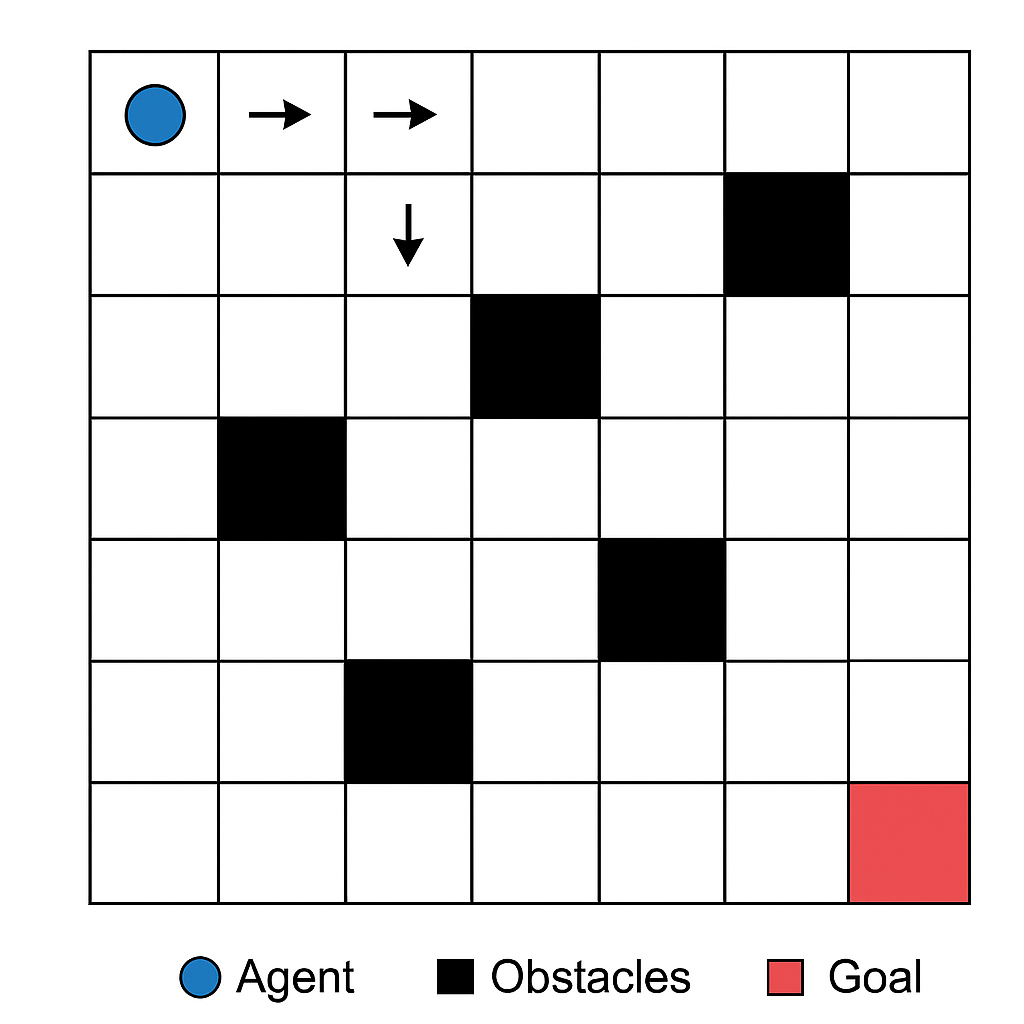
Can deep RL agents acquire core knowledge priors and compose them across tasks? I trained PPO agents (custom CNN policy) on a curriculum of manipulation tasks in procedurally generated, ARC-inspired grid worlds, bootstrapped with imitation from a BFS planner. Finding: agents learned task-specific mappings but did not transfer latent task structure across environments. Joint online RL and offline distillation sped up convergence within a task, but did not fix cross-task generalization. Also explored meta-learning, test-time adaptation, inverse RL, pretraining, and open-ended learning. Advised by Prof. Gautam Shroff.
Active Learning for Object Detection: From Foundation Models to Geometric Insights
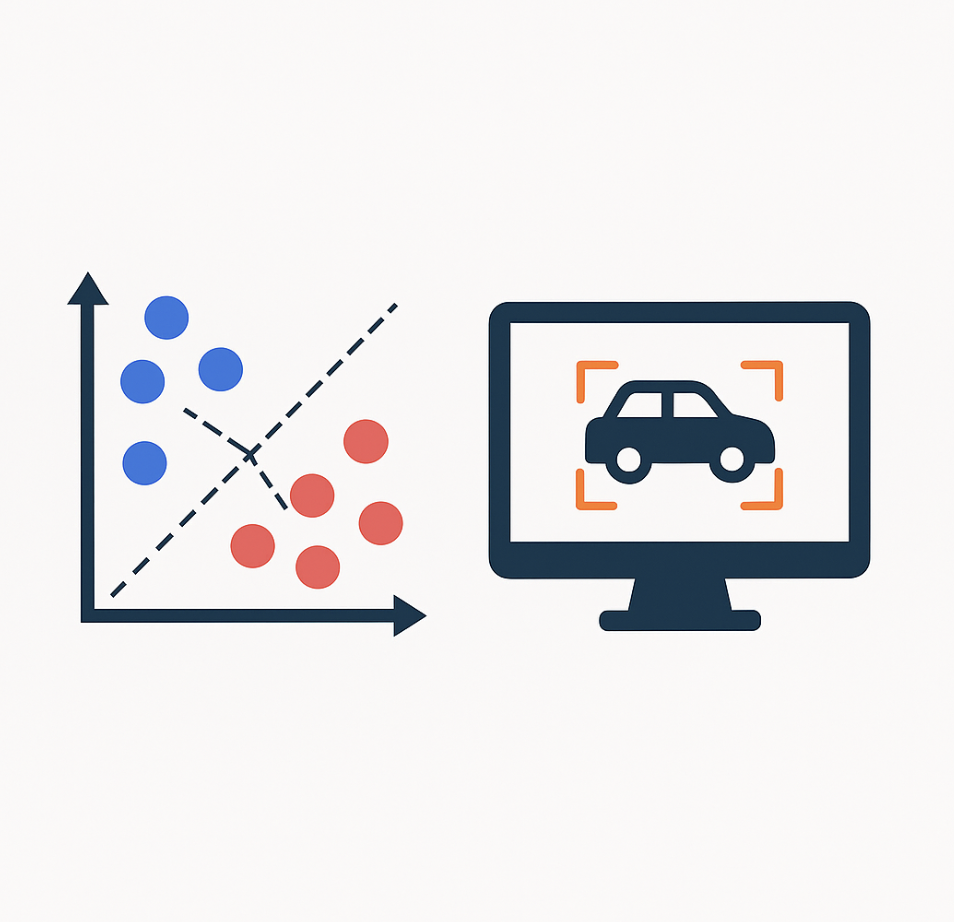
Semi-supervised active learning framework for object detection that combines foundation models with human-in-the-loop annotation. Uses Neural Collapse to build a targeted acquisition function, which enables efficient training under tight annotation budgets and strong performance with minimal human supervision.
work experience
Spyne: Applied AI Researcher
Feb 2026 – May 2026, Gurugram, India- Built an automated visual QC pipeline for dealership images on top of vision-language foundation models (CLIP, DINOv3, SAM 3). It processes 100K+ images per day and cut manual review by about 60%.
- Engineered a blob-based segmentation quality checker (local texture estimation plus morphological filtering) that flags noisy masks before downstream validation.
tbo.com: Software Engineer
Jun 2025 – Jan 2026, Gurugram, India- Redesigned the hotel-search API architecture across S3, DynamoDB, and Aerospike, cutting end-to-end latency about 5x (20s to 4s).
engineering

Raft: Distributed Hash Table
Implemented a distributed key-value store on top of a from-scratch implementation of the Raft consensus algorithm. Includes a custom leader lease implementation that ensures fault tolerance and log consistency across distributed nodes.
VXGI: 3D Graphics Rendering Engine
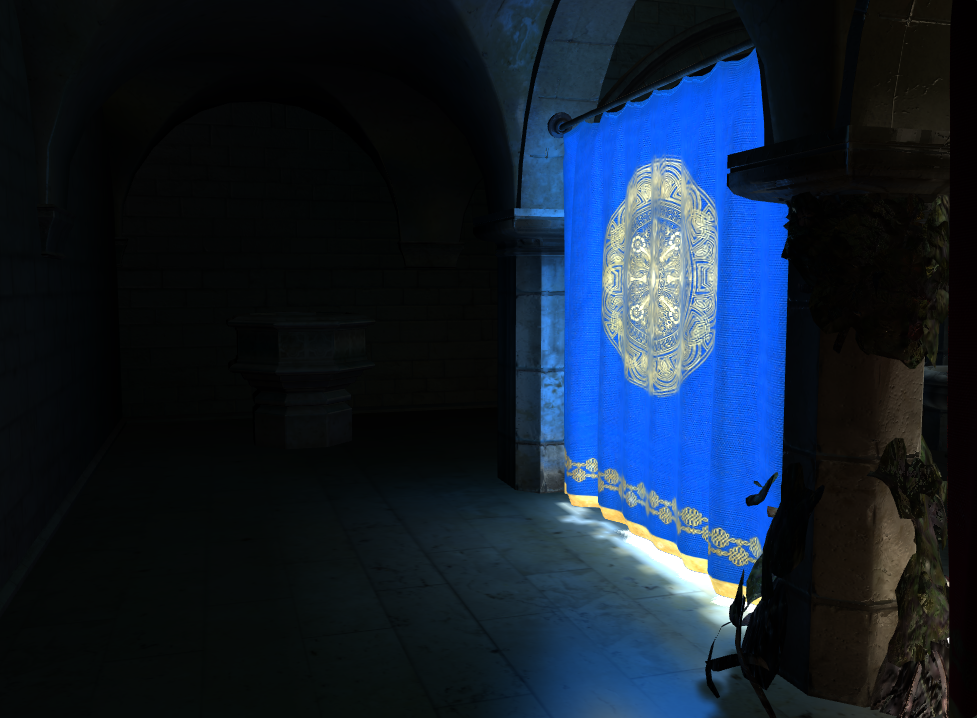
Wrote a rendering engine from scratch in raw OpenGL for real-time global illumination. Implemented a custom dynamic voxelization algorithm with voxel cone tracing for indirect lighting, achieving real-time performance while maintaining visual fidelity comparable to offline rendering techniques.
teaching & awards
CSE544: Computer Vision
- Head Teaching Assistant for the Computer Vision course taught by Prof. Saket Anand at IIIT Delhi (Spring 2025). Led a team of 6 TAs, supported 150+ students, and ran office hours.
- Won the Best Teaching Assistant Award for the academic year.
Awards
- Distinguished Academic Excellence Award, IIIT Delhi: 3 A+ grades in graduate AI courses (Computer Vision, Meta-Learning, Explainable AI).
- Dean's List, 2024–25.